
The Compliance Engine — Active Compliance, Not Another Filing System
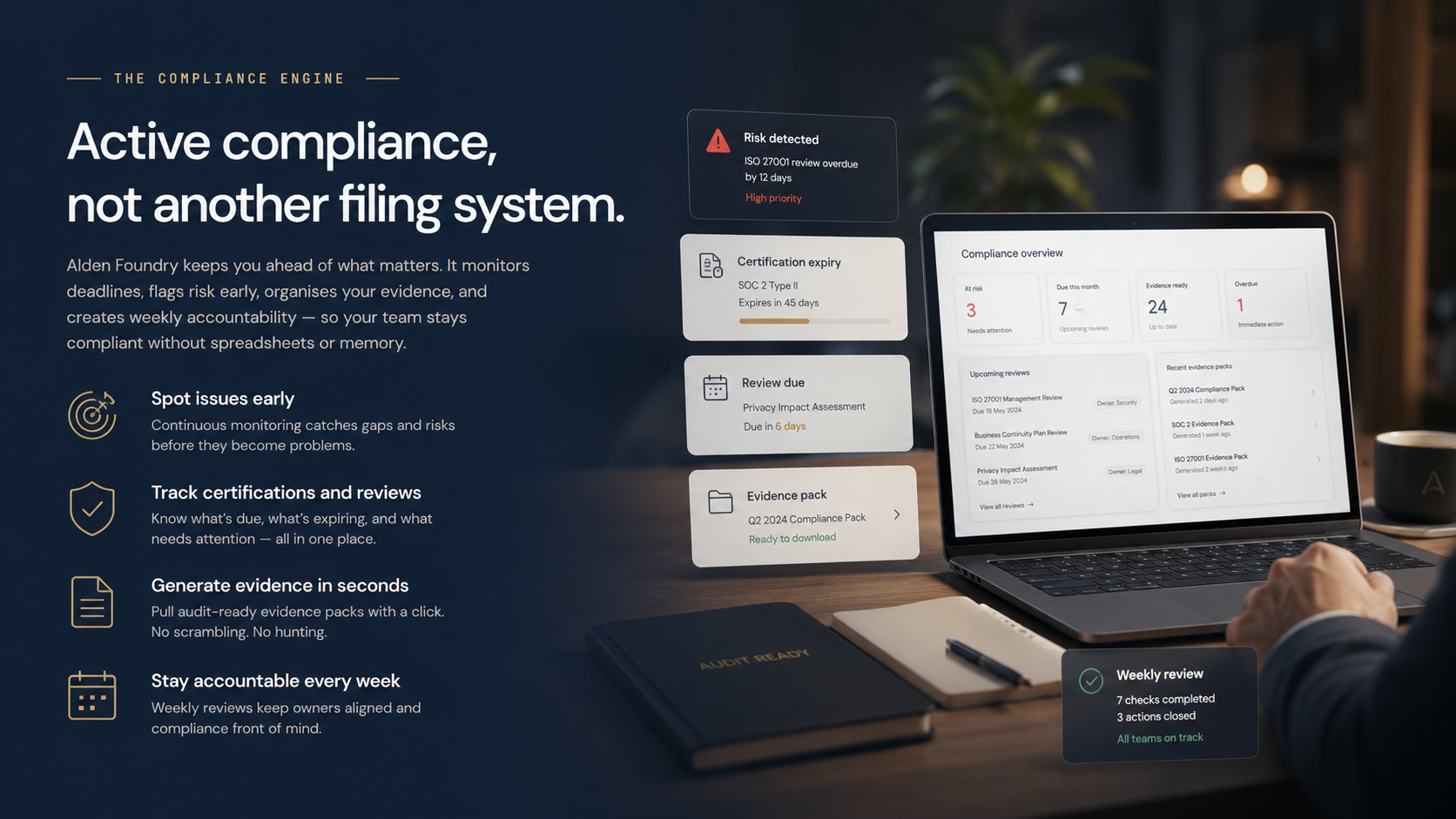
Every regulated UK firm runs compliance from spreadsheets and one person's memory. The Compliance Engine replaces that with a two-layer platform that monitors, assesses, and holds the line.
Regulatory Sources
10+ monitored daily
Audit Prep
Days → seconds
Staff Turnover
Zero knowledge loss
Executive Summary
The Pattern
Every regulated UK firm runs compliance from spreadsheets and one person’s memory. No alerts, no regulatory monitoring, institutional knowledge lost on every staff change.
The Engine
Two-layer platform: structured compliance modules plus an agentic intelligence layer that monitors regulatory sources, assesses firm-specific impact, and enforces weekly accountability.
The Difference
Replaces external consultancy retainers, legislation databases, and 8–13 hours/week of manual compliance administration. Full continuity across staff transitions.
The pattern we see in every regulated firm
The legislation exists. The standards are published. The obligations are well-defined. The problem is never knowledge — it's keeping up.
Every regulated UK firm we talk to is running some version of the same setup: a compliance officer managing certification expiries, document review dates, legislative obligations, and audit schedules across spreadsheets, Monday.com boards, and calendar reminders. The system is passive. It stores data. It doesn't act on it.
When a fire risk assessment goes 11 months overdue, nothing raises the alarm. When a statutory instrument is amended, nobody cross-references it against your method statements. When the compliance officer leaves, everything they carried in their head leaves with them — and the replacement spends three months rebuilding a picture that was never written down.
Most firms fill the gap with an external consultancy — typically £3,000 to £8,000 a year for regulatory monitoring and periodic audits. These services are good, but they operate at arm's length. They send generic bulletins. They can't see inside your systems. They can't tell you at 7am that a certificate expires in 14 days and you have a live project that depends on it.
Two layers, one platform
Layer one: structured compliance modules.
Training and competency tracking, document control, incident and event logging, recurring task scheduling, vehicle and asset management, supply chain accreditation, environmental registers. Each module works independently — a firm can start with just the training matrix and expand over time. Every module accepts spreadsheet import because that's where the data currently lives. The system is structured by design: you can't accidentally file a COSHH assessment in the vehicle register.
These modules are what we delivered for clients like Ekspan and Centar. They replace the spreadsheets, the paper forms, and the manual workarounds. But on their own, they're still passive — better organised, better secured, but still waiting for a human to check them.
Layer two: agentic compliance intelligence.
A centralised regulatory intelligence service monitors official UK sources — legislation.gov.uk, HSE bulletins, enforcement notices, Building Safety Regulator announcements, BSI and ISO publications, industry body circulars — on automated daily and weekly schedules. When it detects a relevant change, it doesn't send a generic alert. It runs an impact assessment against your firm's specific data: your sector profile, your active legislation register, your document library, your training matrix, your obligation register.
The output is contextual, not broadcast. Not “the Work at Height Regulations have been amended.” Instead: “this amendment affects your principal contractor obligations on an active project, and your fall protection method statement was last reviewed eight months ago.”
Every module has associated agents operating within configured autonomy levels. Monitoring and alerting agents run autonomously — expiry scanners, regulatory feed polling, overdue task reminders. Classification agents assess incident severity and RIDDOR reportability. Report generation and impact assessment agents produce outputs for human review. Document generation and register updates require explicit approval. The defaults skew toward human oversight. This is a regulated-industry product. The engine's job is to surface, classify, and recommend — not to make compliance decisions on your behalf.
The commitment layer.
Software with alerts is still easy to ignore. The Compliance Engine includes a structured weekly accountability session — a guided review of everything that needs attention: regulatory updates detected that week, expiring certifications and documents in the next 30 days, overdue tasks and incomplete investigations, compliance score trends, and agent recommendations requiring approval.
The tone is direct. Good news is delivered warmly. Overdue items are stated plainly, with the specific regulation cited and a recommended action attached. No corporate hedge language. If an item is overdue, the system says so, says why it matters, and asks when it will be done.
Overdue items cannot be dismissed. They can be completed or rescheduled with a reason. If they're ignored, they resurface with increasing firmness. If commitment sessions are missed, the system reduces agent autonomy and escalates. It does not accept “we've been busy” as a compliance status.
This is what an external consultancy provides — structured accountability — delivered as software that sees inside your systems in real time.
What it replaces
For a 30 to 60 employee regulated firm, the Compliance Engine typically displaces:
An external SHEQ consultancy retainer (£3,000–£8,000/year) and commercial legislation database subscriptions (£1,000–£3,000/year) — replaced by the regulatory intelligence service with contextual, firm-specific output rather than generic bulletins.
Eight to thirteen hours per week of compliance officer time currently spent on manual expiry checking, legislative monitoring, spreadsheet maintenance, and audit preparation — automated across the modules and intelligence layer.
Two to three days of audit preparation when a client arrives at short notice — replaced by evidence pack generation in seconds.
And the cost that never appears on a P&L: the weeks of institutional knowledge lost every time a compliance officer leaves. The engine retains every obligation, every review date, every past assessment. The replacement inherits a complete compliance state on day one.
Why this matters for Alden Foundry clients.
The Compliance Engine is the layer beneath every platform we build. When we deliver a training matrix for a surfacing contractor or a quality workflow for a structural bearing manufacturer, it doesn't exist in isolation. It connects to the obligation register, the document library, the incident log, the regulatory intelligence feed. A certificate expiry isn't just a training gap — it's a compliance exposure on an active project, and the system knows both.
That cross-module intelligence is what separates a bespoke application from a bespoke platform. And it's what makes the Alden Foundry approach — Map, Connect, Forge — a permanent operational improvement rather than a one-off build.
If your compliance depends on one person and one spreadsheet, we should talk.
The Compliance Engine is included in every Alden Foundry Replace engagement.